
Diamond Enters the GPU Cold Plate: A New Thermal-Management Product
Frore locally integrates a 7 × 7 mm diamond spreader over GPU hotspots in a liquid-cooling plate. Product architecture and test boundaries are public, while temperature and efficiency claims still need independent verification.
On October 7, US thermal-management company Frore Systems announced LiquidJet Diamond, a liquid-cooling plate for GPUs. Unlike a conventional cold plate, it integrates a diamond spreader on the underside to improve cooling at localized GPU hotspots. The company reports headline figures: support for hotspot power densities up to 770 W/cm², a 16–22°C lower GPU temperature than a conventional skived-fin cold plate, and 30%–35% more AI tokens per watt.
Frore is not a diamond producer. The company develops thermal technologies for electronics and introduced its LiquidJet liquid-cooling plate for data centers in October 2025. Its three-dimensional short-loop, multistage cooling structure directs coolant toward GPU hotspots. LiquidJet Diamond builds on that platform by adding diamond.
The placement of diamond in this system is worth a closer look.
Rather than replacing the entire copper cold plate with diamond, Frore locally integrates diamond into the plate’s underside, aligned with the areas of highest GPU heat flux. The product card shows a 7 × 7 mm diamond piece. The cold plate designed for NVIDIA GB300 is approximately 104.6 × 62 × 20.4 mm overall. The diamond is only a small part of the assembly.
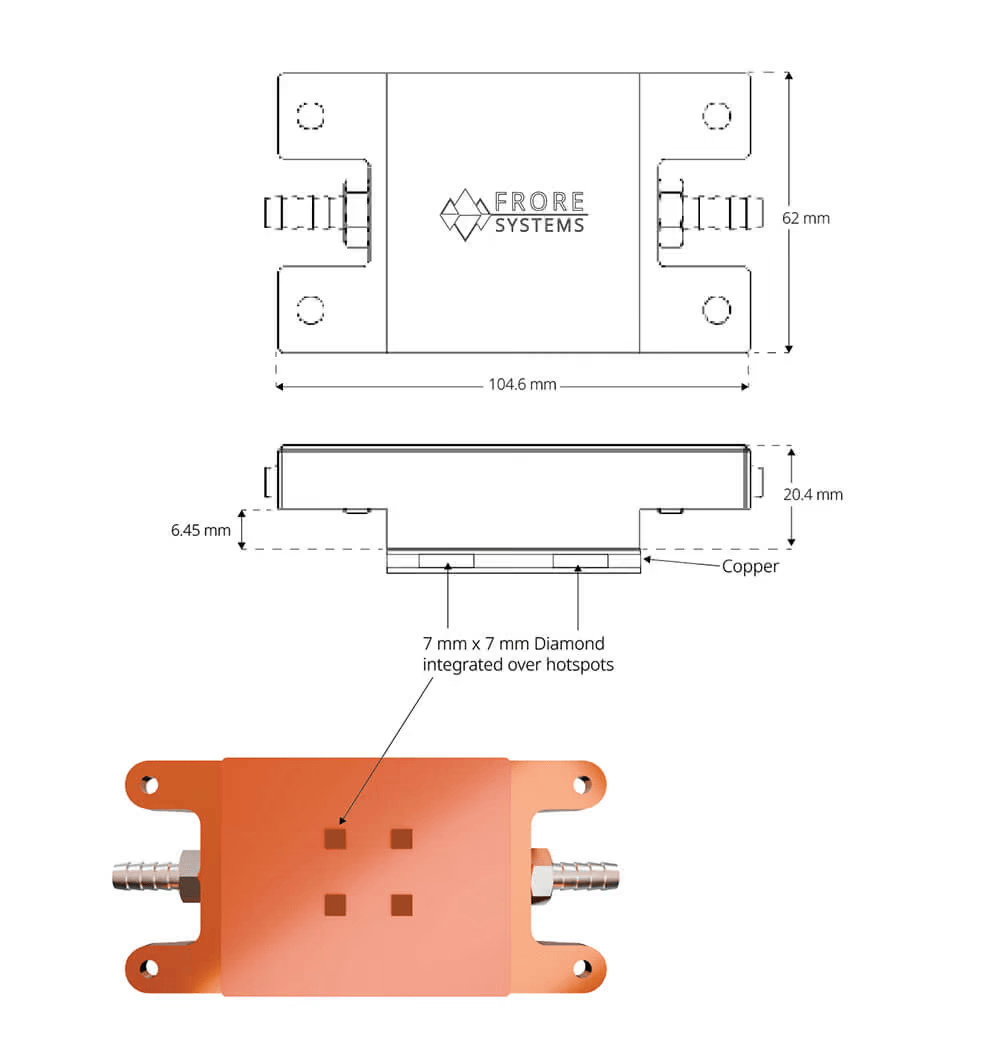
This design has practical logic. Heat flux is not uniform across a GPU, and local hotspots can constrain chip performance. Diamond can spread heat more effectively near those hotspots, while microchannels in the copper plate carry it away. That concentrates the use of a high-value material where it may matter most, instead of requiring diamond across a large area.
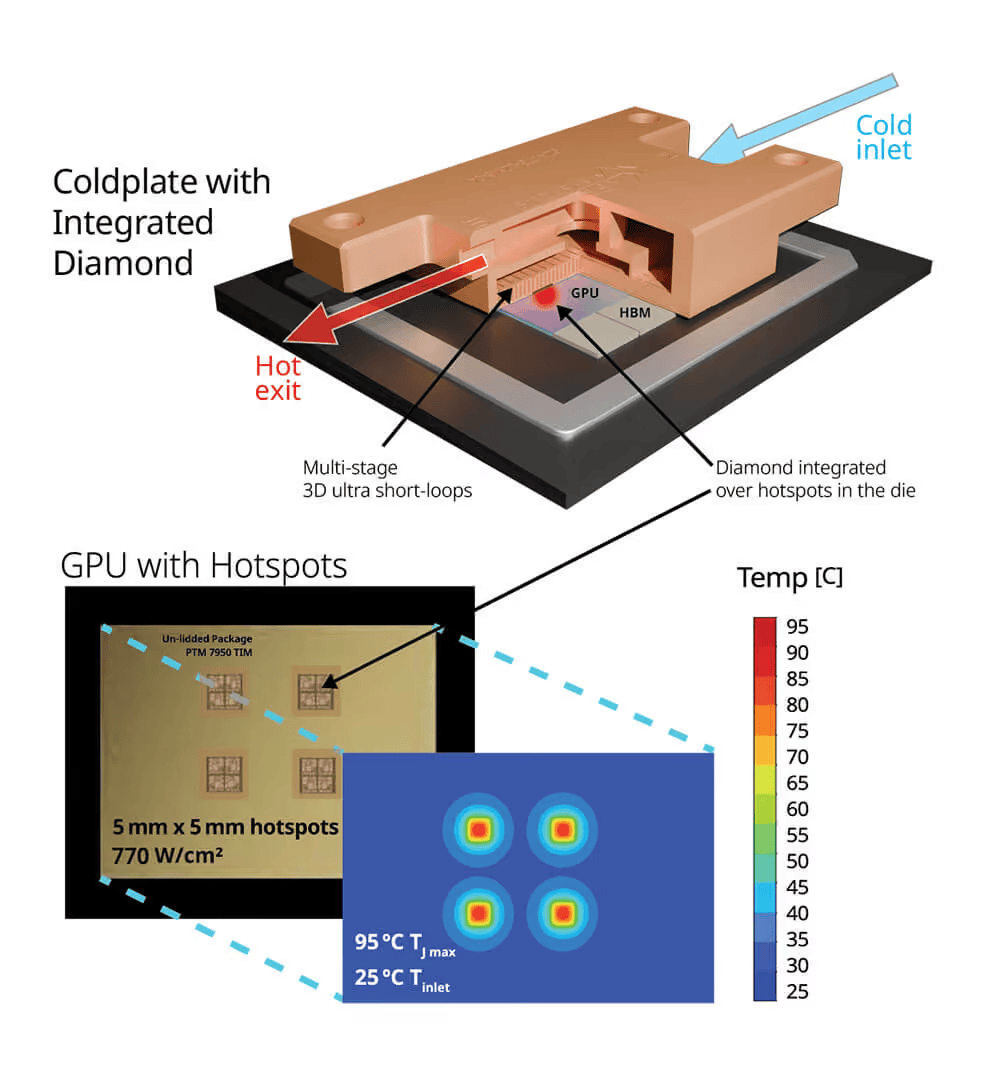
Frore’s 770 W/cm² figure comes with specific test conditions: a 5 × 5 mm hotspot, 25°C coolant inlet, a maximum junction temperature of 95°C, PTM7950 as the thermal-interface material, and a delidded package. According to the company, the original LiquidJet design lowers GPU temperature by about 12°C versus a conventional cold plate, while adding a localized diamond spreader reduces hotspot temperature by a further 10°C.
These figures currently come mainly from Frore’s own technical materials; a complete report enabling independent replication has not been identified. In particular, the 16–22°C temperature reduction and 30%–35% improvement in AI tokens per watt compare the complete cold-plate solution with a conventional plate. They should not be credited to diamond alone. Still, Frore has disclosed a concrete product architecture, material placement and some test boundaries—evidence closer to an end-use application than a demonstration of a high-conductivity diamond coupon by itself.
For companies developing and manufacturing CVD diamond, this offers one product route worth studying: process diamond into a localized heat-spreading component for hotspot regions and integrate it with an existing liquid-cooling system, rather than selling thermal conductivity as a standalone material metric.
Several questions remain before this route can move toward broader deployment. Frore has not fully disclosed whether the diamond is single-crystal or polycrystalline, its thickness, supplier, or the joining process used with the copper cold plate. High intrinsic thermal conductivity does not remove interface resistance between the diamond, chip and plate. Differences in thermal expansion may also affect long-term thermal-cycle reliability. For material suppliers, dimensions, thickness, surface quality and batch consistency will matter to supply capability.
These questions call for further product validation; they do not mean the design is unworkable. Frore has placed diamond in a specific GPU cold-plate design. The next evidence to watch is independent system testing, long-term reliability and actual customer adoption.
Another US company, Akash Systems, was working to bring diamond cooling into AI servers before Frore’s announcement.
Akash’s Diamond Cooling uses a different integration route, and its material structure is not identical to Frore’s. In December 2024, Akash announced a $27 million contract with Indian cloud provider NxtGen for diamond-cooled AI servers. In February 2026, Akash announced delivery of NVIDIA H200 GPU servers using its diamond-cooling technology to NxtGen; NxtGen subsequently confirmed the collaboration and deployment through its official social account.
In March 2026, Akash also announced a partnership with server manufacturer MiTAC Computing to introduce diamond-cooled servers using AMD Instinct MI350X GPUs. The company disclosed an initial order valued at $300 million, but the end buyer, actual delivery volume and payment status have not been independently established in sufficient detail.
Compared with Frore’s cold-plate product announcement, Akash has publicly described a named customer and server delivery. Delivery, however, does not by itself establish long-term reliability, cost competitiveness or high-volume commercialization. Nor can the different temperature-reduction figures reported by the two companies be used to rank their approaches without comparable test conditions.
Together, the two cases point to a development worth watching in diamond thermal management: companies outside China are combining diamond with existing GPUs, liquid-cooling plates and server products. Frore offers a clearly described localized-diamond cold-plate design, while Akash has reported a customer receiving servers. Diamond thermal management is no longer limited to material-property research and laboratory samples; companies are developing products around specific use cases and pursuing customer adoption.
For companies in China developing single-crystal or polycrystalline CVD diamond heat spreaders and diamond-composite thermal materials, these cases offer useful reference points. The material requirements and processing routes differ, but customers ultimately need answers to the same questions: where does the material sit in the cooling system, how much does it change actual temperature, how readily can it be integrated, will it remain stable over time, and does its application value justify its cost?
I consider Frore’s LiquidJet Diamond announcement a development worth following. It adds a product case for diamond in GPU liquid cooling and shows how localized hotspot cooling could be a concrete setting in which diamond’s material properties are used. How far the approach scales will depend on customer validation and volume delivery.
For those working in diamond thermal management, the more important signal may not be the 770 W/cm² figure alone, but the increasingly concrete product form and application requirements. Diamond’s high thermal conductivity becomes cooling performance that customers may adopt only when material, processing, interfaces and system integration work together.
Sources
Frore Systems: October 7, 2026 announcement; LiquidJet Diamond product page and data card.
Akash Systems: 2024 NxtGen contract announcement; February 2026 server-delivery announcement; March 2026 MiTAC partnership announcement; NxtGen’s confirmation.
Evidence limits and uncertainties
- Frore's 770 W/cm², temperature-reduction and tokens-per-watt figures are company-reported; a complete independent replication report has not been identified.
- The reported 16–22°C reduction and 30%–35% increase in AI tokens per watt compare complete cooling solutions and cannot be attributed entirely to diamond.
- The diamond grade, thickness, supplier, copper-bonding process, production capacity and customer adoption have not been fully disclosed.
- The end buyer, delivered volume and payment status behind Akash's reported $300 million initial order have not been independently established in sufficient detail; test conditions across companies are not directly comparable.
Sources
- LiquidJet Diamond Coldplates Can Increase AI Factory Profitability by up to 35%|Frore Systems
- LiquidJet Diamond product page and data card|Frore Systems
- Akash Systems signs $27 million contract with NxtGen|Akash Systems
- Akash Systems delivers diamond-cooled NVIDIA GPU servers to NxtGen AI|Akash Systems
- Akash Systems announces diamond-cooled AMD Instinct MI350X servers with MiTAC|Akash Systems
- NxtGen confirms its collaboration with Akash Systems|NxtGen